SCOPE Newletter


A Letter from the Editor:  Elections and Information Overload
by Steve Maloney RRT

Each quarterly Scope Newsletter solicits  Respiratory Managers for articles in the Manager’s Forum.  The summer issue’s topic was Decreased Reimbursement and Healthcare Reform.   This issue is devoted to election of leaders.  
For many of us November had too much information and relentless advertisements by candidates running for public office. Too often we have little time to sort through information on candidates or even vote.   As respiratory care practitioners we also have elections on the state and national level of the AARC.   I wish to highlight some themes from candidates who ran in the AARC national elections for vice president.  Here in this quarterly issue, our readers will get a glimpse of how we are attempting to improve our profession through communication and legislation.   Later issues will not go into as much detail on the national level, since this publication does not wish to duplicate AARC communications.   But if you want to know who are “movers and shakers”, glance at the following:


Michael Hewitt RRT, Director of Respiratory Care at Saint Joseph’s Hospital, Tampa, Florida, emphasizes increasing membership and participation in the AARC.  He personally recommends responding to the challenge of RCP’s  to be front-line, solutions oriented professionals.  He suggests mentoring students to become future leaders for our profession.


Susan Rinaldo-Gallo RRT, Health System User Analyst for Respiratory Care at Duke University Health System in Durham, North Carolina, prioritizes increased marketing and validation of therapists, by supporting the AARC House of Delegates, Capitol Hill activities, and bench marking our efforts.   She has worked at Pulmonary Rehabilitation regulations and reimbursement policies.  A formal mentoring program is her recommendation for mentoring new leaders in the AARC.


Robert McCoy RRT, Director of Valley Inspired Products Inc. Apple Valley, Minnesota, sees that increasing the science and research of respiratory care will provide improved outcomes and economic value to our industry.  He suggests that clinicians get involved in each state’s professional organization. 


George Gaebler RRT, Director of Respiratory Care, Upstate University Medical Center, Syracuse, N.Y., says his top priority is passing the Medicare Respiratory Therapy Initiative HR 1077/S 343, and a means for AARC officials to speak to Senators and Representatives to pass legislation. 


Each of the above candidates has extensive experience in AARC activities.  The New Jersey Society invites our members to explore opportunities in State Board Meetings each third Thursday of every even month at St. Peter’s Medical Center, New Brunswick, at 6:30 PM.  Any managers willing to write for this Newsletter are asked to submit your article to the Manager’s Forum at NJSRC.org.


Not a Job, an Adventure
by Steve Maloney RRT

 Recently, a facility requested portable oxygen for a complex diabetic patient prior to discharge.  It was reported that the patient and family were capable of managing home oxygen, tracheostomy aerosol, nebulizer, and suction.  The man was obtunded and flat on his back in bed.  He denied that he knew how to manage his respiratory equipment.  He was scheduled for a Friday discharge and adamant about going home.  Further inquiry disclosed no supportive people in his home but an infrequent visiting friend.  A respiratory therapist took immediate responsibility for comprehensive training prior to discharge.  She insisted that discharge was conditional to demonstrating competency in all therapies.  It was recommended to provide all supply delivery one day prior to discharge so to begin orienting the family to comprehensive care.   Instead all supplies were delivered on Friday.  The medical transport company did the discharge and would connect the patient from the portable oxygen to the oxygen concentrator at home until the respiratory therapist and visiting nurse arrived.  The home respiratory therapist found the patient connected to an E cylinder which was not turned on.  The visiting nurse contacted a home health agency to arrange for a home health aide the following week.  No sterile water was delivered, and the patient stayed on dry oxygen to a Passy-Muir tracheostomy speaking valve until the water arrived.  Neither the friend nor patient remembered to rearrange the humidification as instructed after the water was delivered.  They contacted the on-call respiratory therapist regarding clarification.  The continuity of care was compromised.


The respiratory therapist’s role in coordinating care cannot be underestimated in the discharge process.


“Not a Job, An Adventure” is a quarterly editorial open to the all Respiratory Care Practitioners in New Jersey.  The title suggests a personal experience which proved a positive learning experience beyond a daily routine. The NJSRC board encourages our readers to forward your story of adventure to SCOPE.  The board reserves the right to edit the story and request a limit of three hundred words.  We invite you to submit your own story or topic related to your job.  Feedback and new ideas will help this publication and our profession flourish.


House of Delegates Report
By Sandra McCleaster RRT, and Steve Maloney RRT

The AARC delegates meet twice a year wherein 50 states come together to conduct business relative to the profession of Respiratory Care..  Each state has two delegates to represent their  state’s interest.  Our delegate,   Sandra McCleaster attended this year’s summer meeting in Florida.  The meetings are information intensive, about which the NJSRC wants our membership to be briefly informed:


Paul Eberle, PhD. RRT, from Utah proposed that the AARC on record agrees with the NBRC renewal policy requiring state licenses have a valid NBRC credential.


Claire Aloan, New York, proposed that the AARC issue in documentation, the need for Respiratory Care Education Programs for all levels of government or related parties where any programs may be in jeopardy of funding.


Jim Lanoha, Louisiana, proposed that the AARC Disaster relief policy be revised for access to AARC disaster relief funds when AARC designated relief efforts may not be federally declared disasters.  Jim also proposed other public or private financial sponsors for the AARC fund besides membership alone, and investigate unreimbursed expenses incurred by therapists involved in National Disasters.


One important topic was the AARC “2015 and Beyond” initiative which is attempting to identity the skills and characteristics which will be needed by future respiratory therapists.    There is a suggestion that that within ten years the entry level criteria for respiratory care practitioners will be a B.S. degree and one credential only.  It was noted that the national AARC membership has reached 50,000.  The State goals are a minimum of 50% AARC members, which New Jersey has accomplished with 1886 members of 3300 licensed practitioners.


The AARC has designed a national public health initiative called Drive 4 COPD challenge.  The initiative requests every state organization to acquire 10,000 screening surveys from the public to inform them of disease awareness, screening, and promote the respiratory profession.  The national effort includes other organizations such as the National COPD foundation, NASCAR, Boehringer Ingelheim, ALA, and celebrities Danika Patrick, Jim Belushi, Michael Straham and more.  The NJSRC president, Erick Cooper, is chairperson for the Drive4COPD committee.


Another AARC initiative is the Peak Performance USA program.  This is an asthma orientation for the public, particularly helpful to school nurses and teachers.  Our New Jersey chapter is looking for input from clinicians who specialize in asthma intervention.  Contact our website at NJSRC.org.


Help!  I’m Jobless.

By Daryl Rogers RRT


Recently, I had the privilege of meeting with upcoming respiratory graduates who were both excited about their new career and yet discouraged about limited job openings.  The excitement of opportunity wasn’t there as it had been in times past when recruiters would meet with students and “beg” for prospects.  Attractive packages with sign-on bonuses accompanied these offers and students were swallowed up by organizations even before they graduated.  But, the winds of time have shifted and, particularly in this economic climate, the job market is slim.  Those soon-to-be RT retirees are no longer leaving and per-diem spots are being snatched up to supplement existing incomes.  So what’s the new graduate supposed to do?  Don’t be discouraged! Here are 2 helpful and encouraging tips to help you land your first job quickly!


1. Start strong!  In our field, I have sadly seen some of the most pitiful resumes ever submitted by respiratory therapists.  Sell yourself upfront and secure that interview!  While you’re respiratory work experience is at a minimum, list clinical practices you’ve participated in.  Moreover, list extra-curricular activities that demonstrate personal commitment and a willingness to grow.  Bear in mind, you are going up against seasoned clinicians who have had years of experience in this arena.  Secondly, never submit a sloppy resume.  Present a well-organized, error-free auto-biography of who you are.  A slapdash resume tells the recruiter 2 things.  First, you didn’t care enough to take the time and effort up front to present yourself well on paper.  Second, if you’re this disorganized now, how will you conduct yourself in front of the patient?  Again, your resume is a brief life story of who YOU are.


2. Look! There are a multitude of places for respiratory therapists to work.  So often, a student, because of clinical experience, will tell me they are going to apply to one of the few “trauma” hospitals where they had clinical rotations.  Well, it’s you and every other graduating student in the state looking for those per-diem jobs.  Diversify your outlook!  There are over 70 General (Acute Care), Medical and Surgical Hospitals in New Jersey.  Additionally, there is an abundance of long-term care facilities, rehab centers, home care companies, sleep labs, and more who seek out RT’s!  While your commute may be a little farther than initially planned and the working hours are not exactly what you sought after, think opportunistically!


You have chosen an awesome career with numerous possibilities!  While openings are less common than years past, solid respiratory therapists are always needed and sought after.  Keep your head up and get looking!


Your New Jersey Society's Successful 2010 Annual Shore Conference
By Steve Maloney RRT

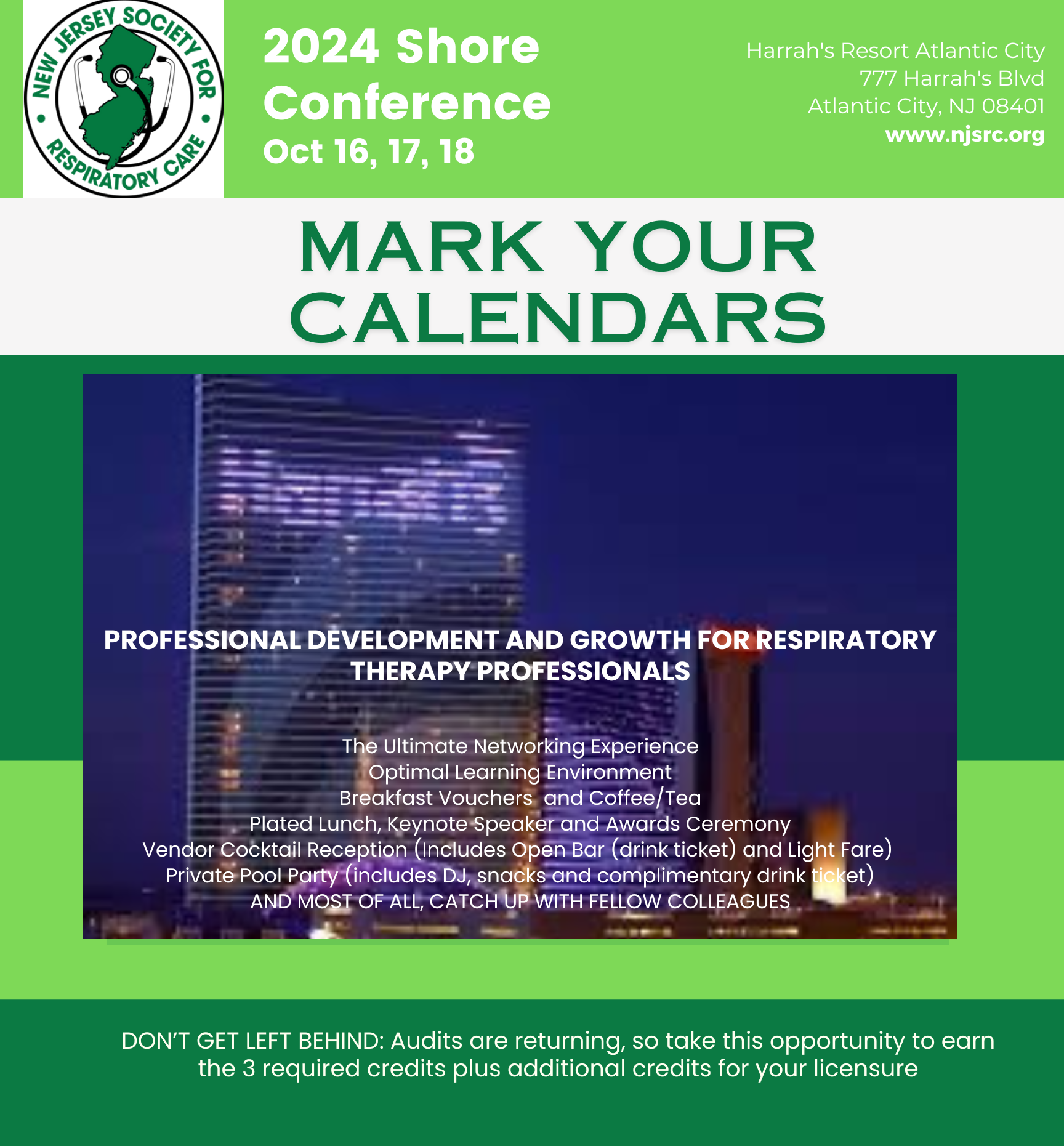
Congratulations  to our chairperson,  Linda Birnbaum, for this year’s Annual Shore Conference at the Taj Mahal Casino Resort in Atlantic City.  On October 6th through 8th committee members Linda Melchor, BS, RRT, NPS, Lisa Shultis, BS, RRT, Jill Guide, RRT, Carol Schedel, MA, RRT, and Joseph Goss RRT assisted Linda with producing a professional and educational forum for providing continuing education units for respiratory care practiioners.  Seventeen lectures on diversified topics related to our industry were available for up to 12 credits. Forty-seven vendors supported the consortium(???) what consortium, Steve?  Do you mean “conference”  by displaying state of the art technology as well as lectures.   Instrumentation Labs sponsored the IL Award to Lori-Ann Ligon RRT.  Carefusion Inc. Sponsored the Practitioner of the year award to James Uyami RRT, AtHome Medical.  Other practitioner nominees included Racheal Ruf RRT, St. Joseph’s Hospital, Rose Litterini, Educator Respiratory Care, Hackensack University Medical Center  and runner up Uma Anand of Mountainside Hospital.l   Erick Cooper, NJSRC president, provided the Vendor of the Year award to Maquet Inc. 
Student excellence awards were presented to Iwonna Wypych of UMDNJ North, Colleen Reece of UMDNJ South, Cory Fisher of Brookdale Community College, Jennifer Vincent, Northwest NJ Consortium, and Donald Healy of Bergen Community College.   The Brookdale Community College team won the Sputum Bowl academic competition.  Congratulations to students Matthew Webster, Cory Fisher and Megen Stecz.

The New Jersey Society had our annual meeting during the conference as well.  Each year respiratory care practitioners are encouraged to attend our meeting to exchange information and participate in helping improve our industry.  A Special Election of board officers was conducted prior to the meeting and the results were presented.  Ray Kijowski is President-Elect, effective Jan. 2011.  Linda Melchor is Vice President, Al Toplitz was re-elected treasurer.  Michele DaSilva is secretary.  Steve Maloney and Lori Ligon were elected Directors-at-Large.  Dianne Adams is our newest delegate to the AARC.  Lisa Shultis is our Northern Region Director, and David Orloff is our Southern Region Director. 

The effort which this conference committee and volunteers made to our membership is profoundly appreciated, not only for the CEU’s but the advancement of our profession and quality of life.  Our special thanks to the New Jersey Hospital Association for facilitating the conference, elections, and Scope publication.


NJSRC Welcomes our Membership to our Board’s 2010-2011 Strategic Plan
By Steve Maloney RRT

Change is inevitable but to create change takes a plan and work.  The purpose of the NJSRC is to promote our profession.  Here are plans to take action for our profession in the next year.


1. Improve communication to RCP’s by means of a communication committee (which sponsors the Scope newsletter).
2. Better utilize the website NJSRC.org
3. Conduct a survey of RCP’s to elicit pertinent information and action by your board.
4. Expand e- mail service.
5. Design a welcome package to new members.
6. Identify therapist core needs.
7. Representation of NJSRC board to the NJ State Board
8. Political rapport with lobbyist.
9. Mentor new board members.
10. Create a board succession plan.
11. Provide a board sponsored conference to other professional organizations.
12. Increase committee commitments.
13. Specific board member orientation.
14. Ongoing education.
15. Student education. 
16. Networking with hospitals for CEU programs.
17. Public education


RCP’s are encouraged to enroll in the AARC, and provide input at our website NJSRC.org. 

 
powered by MemberClicks